Trading Notes
Algorithms and AI: the new force reshaping financial markets
From rule-based systems to machine learning models, AI has fundamentally changed how modern markets are traded — and what that means for everyone in the game.

Sumanth Hegde
18 Apr 2025 · 7 min read
For most of financial history, trading was a human activity. Analysts read charts, fund managers made calls, traders shouted across floors. Intuition, experience and nerve were the edge.
That era didn't end — but it's no longer the whole picture. Algorithms and AI have become the dominant force in global markets. And understanding what that means is essential for anyone with capital in the game.
The algorithmic revolution
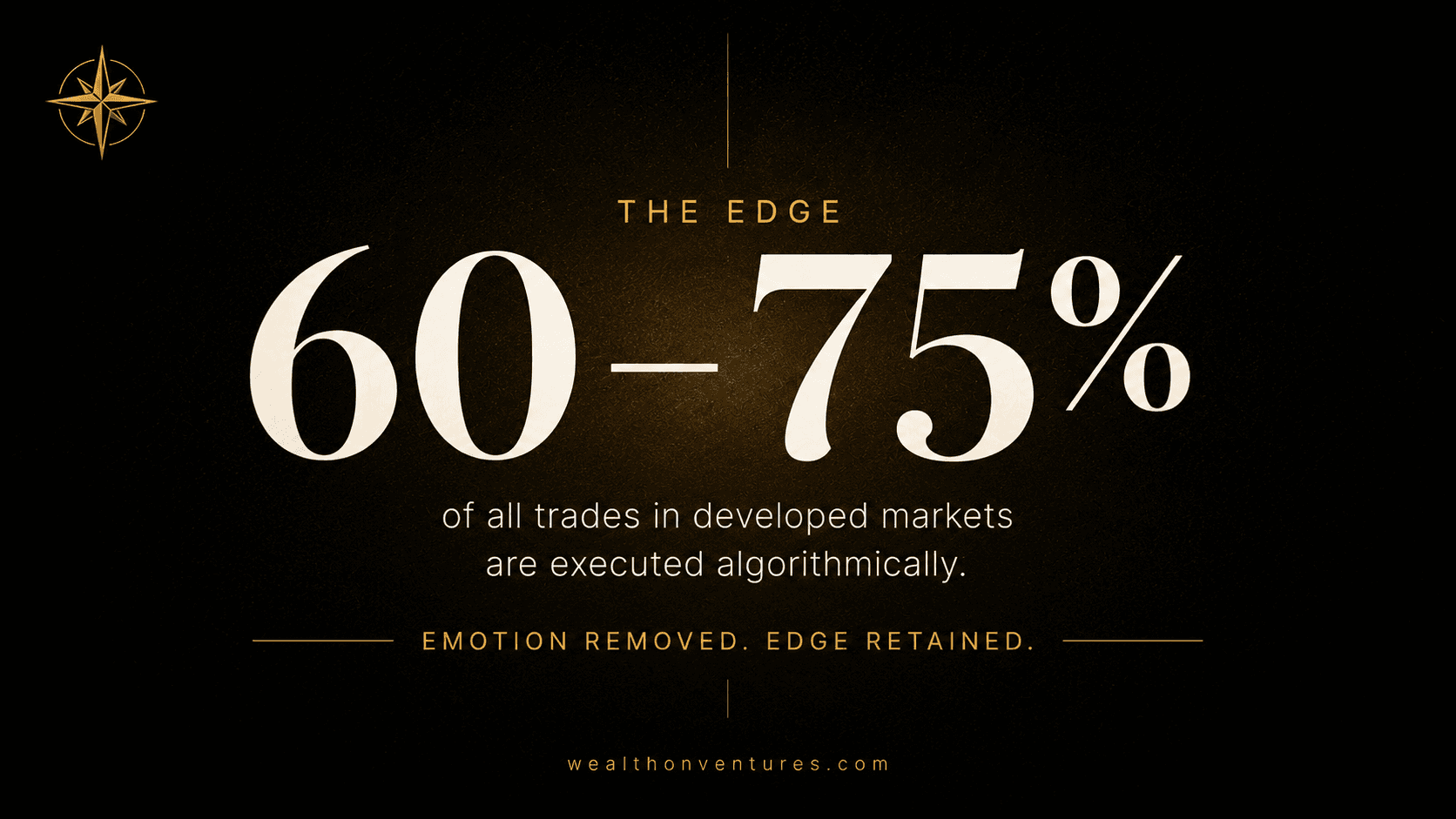
Algorithmic trading — where computer programs execute orders based on predefined rules — began in the 1980s with simple arbitrage strategies. By the 2000s, it accounted for a significant portion of all equity trades. Today, estimates suggest that 60–75% of all trades in developed markets are executed algorithmically.
The reason is straightforward: speed and consistency. An algorithm can scan hundreds of markets simultaneously, identify a signal, calculate position size, factor in risk parameters and execute a trade in microseconds. A human cannot. And crucially, the algorithm doesn't hesitate, panic or get greedy.
Rule-based systems removed execution-level emotion from trading. That alone was a structural advantage. But then came AI.
How AI entered the markets
Machine learning models changed what was possible. Instead of hard-coded rules — "buy when the 50-day moving average crosses the 200-day" — ML models could learn patterns from data that no human had explicitly programmed.
Natural language processing allowed systems to parse earnings calls, central bank statements and social media sentiment in real time, converting unstructured language into trading signals. Computer vision models began reading satellite imagery to estimate inventory levels at oil storage facilities before official reports were released.
Deep learning networks found non-linear relationships in market data that statistical models had missed for decades. Reinforcement learning produced agents that could optimise execution strategies dynamically — learning, from millions of simulations, how to move large positions without revealing themselves to the market.
What this means for markets today
Markets have become faster, more efficient and more crowded at the edges. Classic inefficiencies that once offered easy returns — simple momentum, index arbitrage, post-earnings drift — have largely been arbitraged away. AI spotted them, scaled into them and closed the gap.
This creates a compounding dynamic: the more AI is used, the harder it becomes to find edge without AI. Firms that haven't adapted to systematic, data-driven approaches are competing at a structural disadvantage.
It also creates new risks. Flash crashes — sudden violent price moves with no fundamental cause — are often algorithmic feedback loops. When multiple systems share similar signals and react simultaneously, liquidity can vanish in seconds. The 2010 Flash Crash, the 2015 Treasury market disruption, and several crypto liquidation cascades have all carried this fingerprint.
Where human judgement still matters
AI is not infallible. Models trained on historical data can fail spectacularly in regime changes — market conditions that look nothing like anything in the training set. The early days of COVID-19 broke many quantitative strategies precisely because nothing in decades of data resembled a global pandemic shutdown.
This is why human oversight remains critical. Not to override signals, but to understand when the context has shifted fundamentally. The best systematic operations combine model discipline with human judgement at the boundary conditions.
How we think about this at Wealthon
Our approach is systematic and model-driven, but not blindly automated. We run algorithmic strategies across Forex, Commodities and Crypto — markets with the liquidity and structure that quantitative approaches work well in.
Every strategy is back-tested, stress-tested, and forward-tested with limited capital before meaningful allocation. Risk parameters are built into the system. We don't chase AI as a buzzword — we use systematic, data-backed methods because they produce consistent, reviewable, repeatable outcomes.
The world of trading has changed. Understanding how is the first step to navigating it intelligently.
Wealthon Capital Ventures is a proprietary trading firm. Capital partnerships are profit-sharing arrangements and not fixed deposit schemes or guaranteed return products. All partnerships are governed by signed agreements. Past performance does not guarantee future results. For informational purposes only.
Capital Partnership
Interested in working with us?
Every partnership starts with a conversation. No commitment, no pressure — just an honest discussion about whether this makes sense for you.
Start a conversation →